Black Shuck and the real legends behind The Hound of the Baskervilles
Britain is full of phantom black dogs, and Arthur Conan Doyle borrowed the best of them for his most famous Sherlock Holmes story. Here are the legends behind the hound, and the scene I chose for my print. No spoilers for the ending.
The friend who told Doyle the tale
In 1901 Doyle went walking on Dartmoor with his friend Bertram Fletcher Robinson, a journalist who had grown up in Devon. Robinson told him a west-country legend about a spectral hound. Doyle was so taken with it that the first edition opens with a note to him: "My dear Robinson, It was to your account of a West-Country legend that this tale owes its inception." According to the Robinson family story, the coachman who drove them about the moor was a man named Harry Baskerville.
The wicked squire of Buckfastleigh
The legend Doyle seems to have drawn on most is that of Richard Cabell, a squire of Buckfastleigh on the edge of Dartmoor, who died in 1677. He had a reputation for cruelty, and the story goes that on the night he was buried, a pack of phantom black hounds came howling across the moor to his tomb. The villagers built a heavy stone house over his grave, with iron bars, to keep him in. It still stands in the churchyard of Holy Trinity at Buckfastleigh. Doyle's Hugo Baskerville, the wicked ancestor chased to his death by a hound, feels very close to Cabell.
Black Shuck
Further east is the most famous black dog of all. In East Anglia, Black Shuck is a huge black hound with burning eyes that roams the coast and lanes at night, and seeing him is a bad omen. On 4 August 1577, during a violent storm, he is said to have burst into two churches during services, at Bungay and at Blythburgh in Suffolk, killing worshippers. A pamphlet printed the same year, A Straunge and Terrible Wunder, told the story. At Blythburgh, the scorch marks on the north door are still called the devil's fingerprints.
Dartmoor's wisht hounds
Dartmoor has its own pack too: the wisht hounds, said to hunt the moor on stormy nights. With black dog stories in almost every county, Doyle did not need to invent the legend. He needed to make you believe it, and then make you doubt it.
The scene I chose
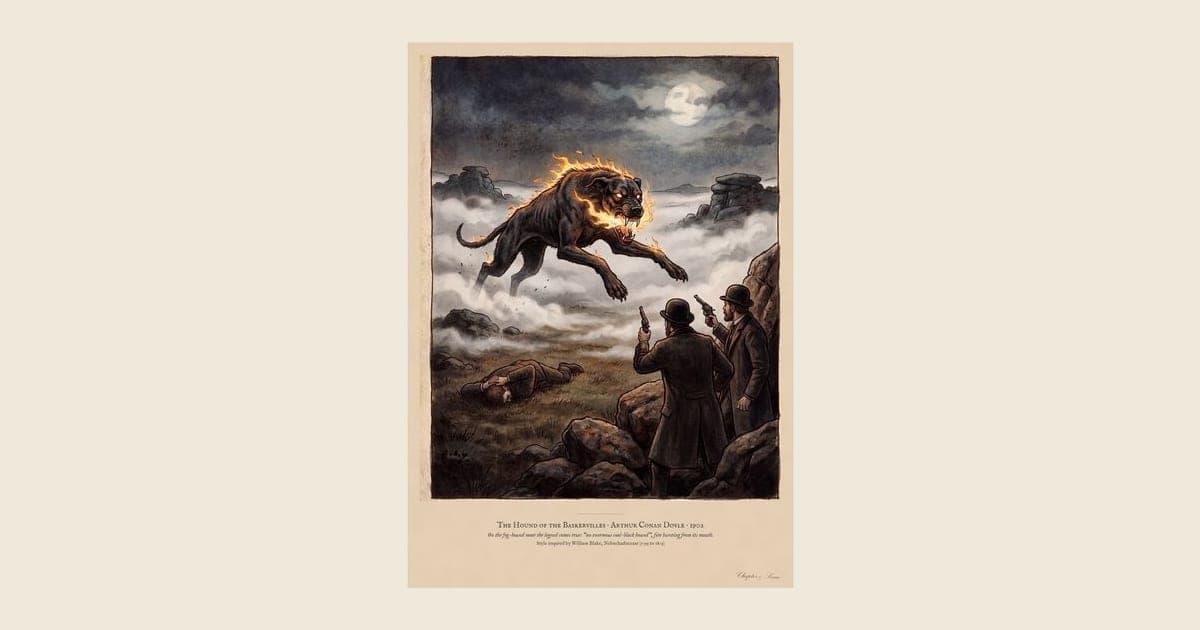
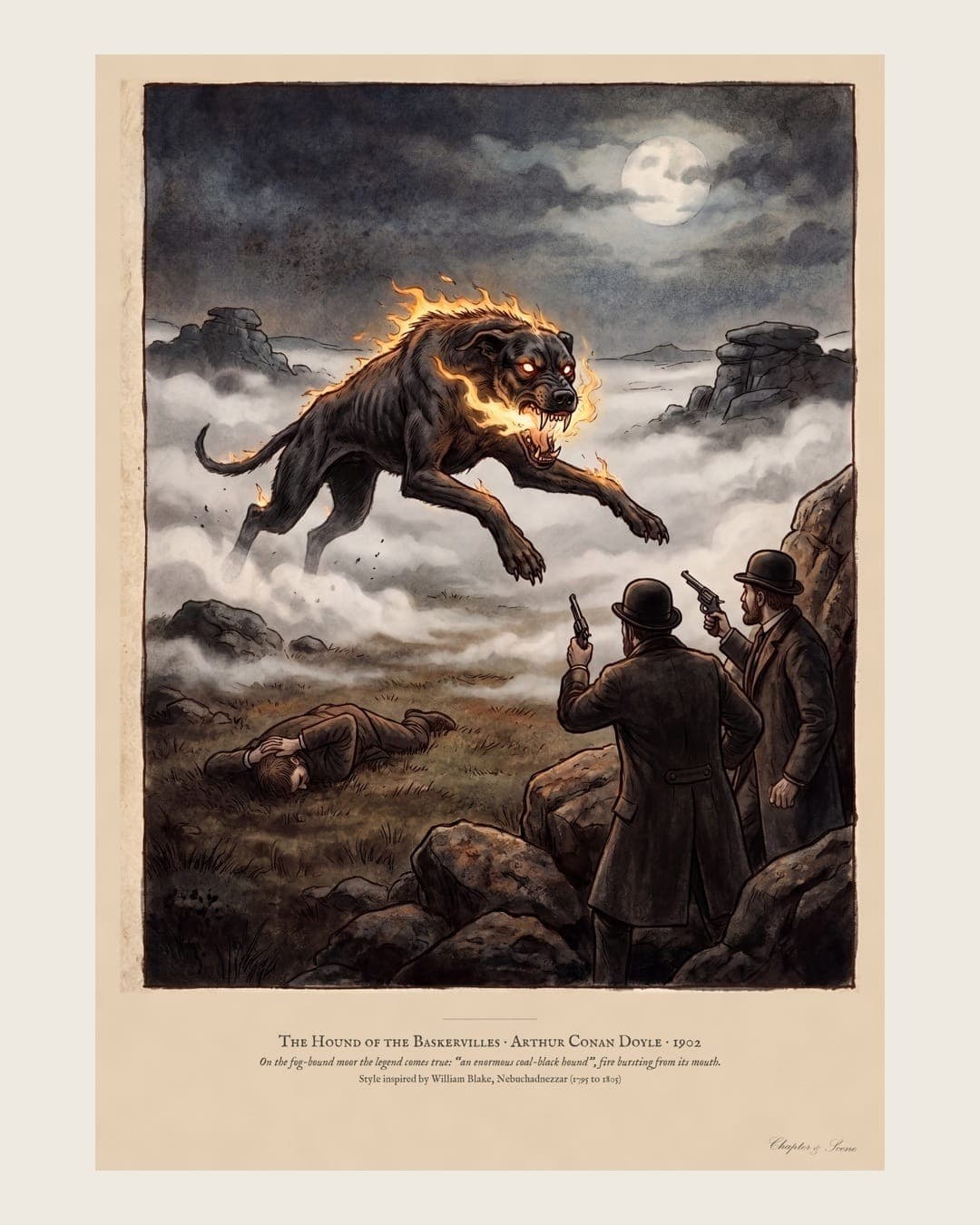
For most of the book, Doyle keeps Watson, and you, half believing in the curse. In Chapter 14 the fog rolls over the moor and the plan begins to go wrong. Then out of the white comes "an enormous coal-black hound", fire breaking from its jaws. That is my print. I made it in the style of a 1790s colour print finished in pen and watercolour, with mottled colour and a rough, haunted line, as if the picture had been printed long before anyone saw the hound. The look comes from William Blake's colour print Nebuchadnezzar, in the Tate.
Read it this October
The Hound of the Baskervilles is short, fast and properly atmospheric, and it is the perfect Halloween book for anyone who prefers a mystery to a monster. Start it on a foggy night.
More: The Hound of the Baskervilles art prints and 11 gothic novels to read this Halloween. My prints are made with AI image tools and art-directed by me.