Dracula in Whitby: the real places behind the novel
Everyone remembers Transylvania, but the most frightening chapters of Dracula happen on the Yorkshire coast. Bram Stoker found the name, the shipwreck and the churchyard in one seaside town, and you can still walk every step of it.
Stoker's holiday in 1890
In the summer of 1890, Bram Stoker, then the manager of London's Lyceum Theatre, took a holiday in Whitby. He stayed on Royal Crescent, on the West Cliff, where a plaque marks the house today. He had already started thinking about a vampire story. Whitby gave him most of it.
The library book that gave him a name
In the town's subscription library, Stoker read a book about Wallachia and Moldavia by William Wilkinson, a former British consul. In it was a prince called Dracula, and a note that the word could mean devil. Stoker copied it into his notes. Until then, his villain had been called Count Wampyr.
The ship that came in on a storm
In Chapter 7, a Russian schooner, the Demeter, is driven into Whitby harbour in a terrible storm with a dead man lashed to the wheel. As she runs aground, an immense dog leaps from the deck and bounds up the cliff into the churchyard. Stoker did not have to invent the wreck. In 1885 a Russian ship, the Dmitry of Narva, ran aground below the East Cliff, and locals still remembered it when he arrived.
The 199 steps
From the old town, a stone staircase of 199 steps climbs the East Cliff to St Mary's Church and its churchyard, with the ruins of Whitby Abbey beyond. In the novel, Mina Murray runs up those steps in the middle of the night, looking for Lucy. Count them on the way up. Everyone does.
The churchyard and the seat
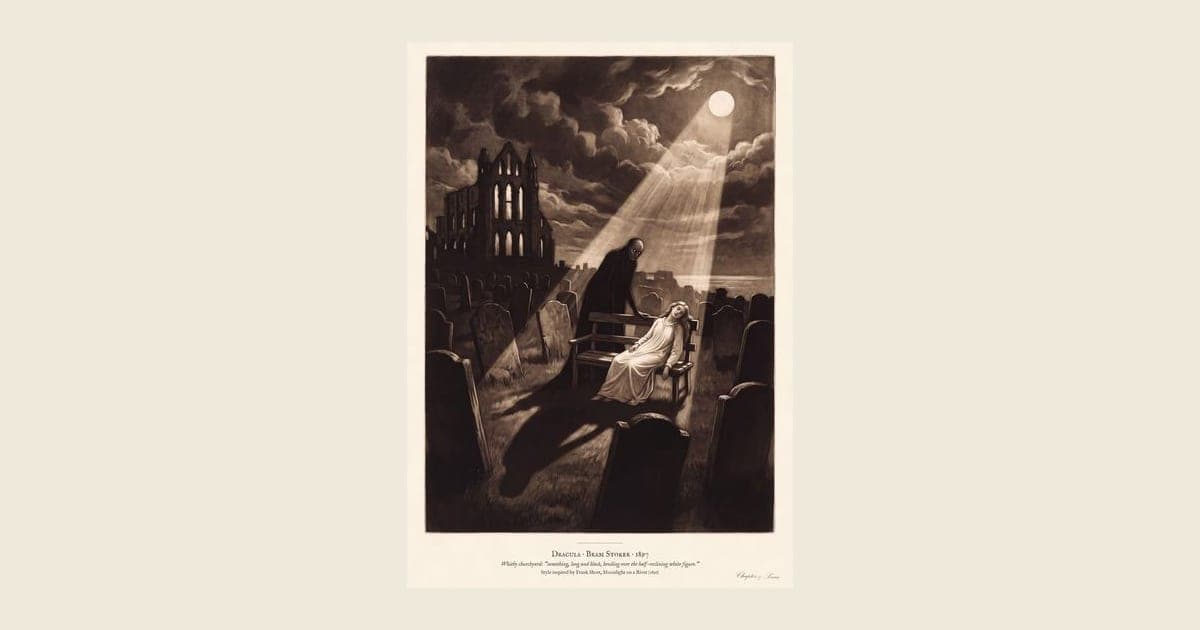
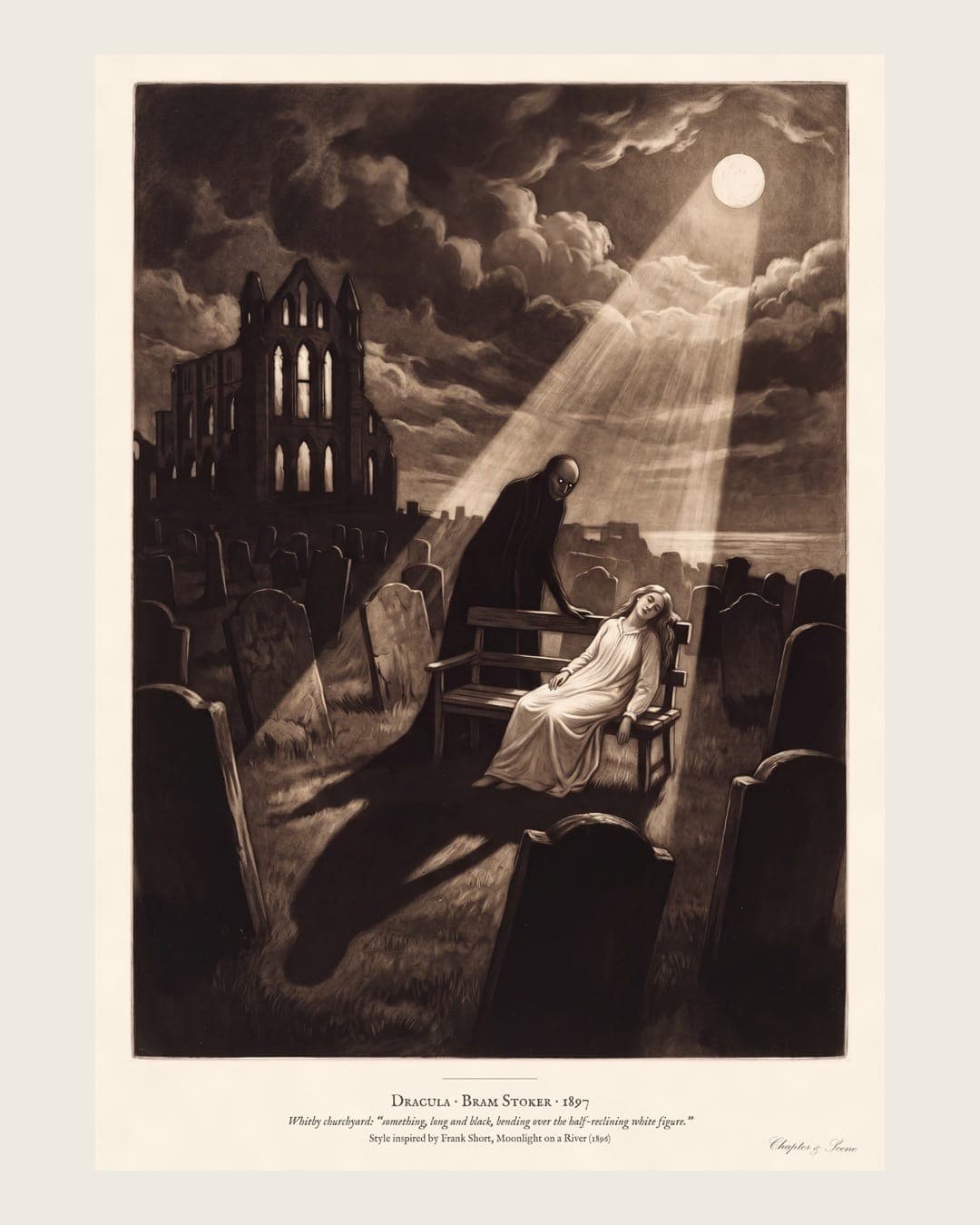
St Mary's churchyard is where Mina and Lucy like to sit, looking out over the harbour. Local tradition says Stoker borrowed names from its weathered headstones. It is also where Chapter 8 happens: Mina reaches the top of the cliff and sees, on their favourite seat, "something, long and black, bending over the half-reclining white figure". That is the scene I chose for my Dracula print. I made it in the style of a Victorian mezzotint, the printmaking of the years Stoker was writing, with one hard shaft of moonlight and the abbey ruins on the skyline.
The abbey
Whitby Abbey was founded in 657 by St Hilda, and the ruins you see now are the Gothic church that replaced it centuries later. Stoker had Mina describe it as noble and romantic, and it still dominates the town from the top of the cliff. On a misty evening it looks exactly like the book.
Whitby today, and the Goth Weekend
Whitby has never let Dracula go. Since 1994 the town has hosted the Whitby Goth Weekend, now held twice a year, in spring and again around Halloween, when the streets fill with velvet, lace and top hats. If you go, climb the 199 steps after dark, stand in the churchyard and look back at the harbour lights. You will see why Stoker kept the town.
Read the Whitby chapters
The Whitby section runs from Chapter 6 to about Chapter 9, through Mina's journal and a newspaper report of the storm. It is the best place to start if you have never read Dracula, and the best place to return to if you have.
More Dracula: Dracula art prints and 11 gothic novels to read this Halloween. My prints are made with AI image tools and art-directed by me.